
基本情報
出展製品・サービス
コンクリートの28日強度発現履歴をリアルタイムに自動計測するシステム
Real-Time Automated Monitoring System for 28-Day Concrete Strength Development
近年、日本の人口減少は著しく、現場管理者の減少も例外ではありません。
したがって、少人化・省力化が求められるようになりました。
従来、コンクリートの強度発現を確認するには、150㎥ごとに【供試体作成~養生管理~試験室への移送~脱型強度確認~7日強度確認~28日強度確認~産業廃棄物処理】といった工程を繰り返していました。1回の強度確認では3本の供試体の圧縮試験を実施するため、合計9本の供試体を製作する必要がありました。しかし、供試体は躯体そのものとは言い難く、測定した強度が躯体のどの部位に該当するかは特定できませんでした。
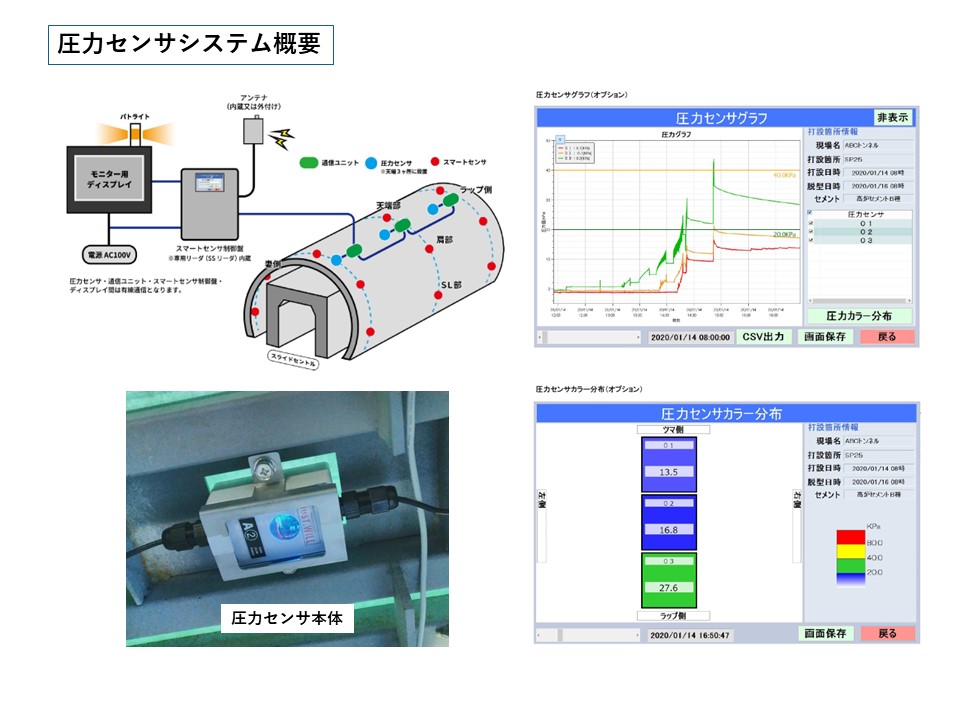
これらの課題を解決するため、打設箇所の強度発現が知りたい場合、各部位ごとにセンサを設置し、躯体から直接情報を収集して、有効材齢による強度推定式により、時々刻々と変化する強度発現を定量化し、グラフなどでビジュアル化して可視化を可能にした技術です。
リアルタイムデータとして共有や保存が可能となりますので、非破壊の遠隔臨場技術とも言えます。
したがって、立会検査の削減や、完成資料の作成においても、より詳しい資料を短時間でまとめることが可能となり、生産性の向上に資する技術となります。
In recent years, Japan has faced a significant population decline, and the decrease in the number of site managers is no exception. Consequently, there is a growing need for manpower reduction and labor-saving solutions in construction.
Conventionally, monitoring concrete strength required a labor-intensive cycle for every 150 m³: specimen preparation, curing management, transportation to testing laboratories, and multiple strength tests at demolding, 7 days, and 28 days, followed by industrial waste disposal. This process requires nine specimens per set. Furthermore, these specimens do not always perfectly represent the actual structure, making it difficult to determine the strength of specific sections.
To address these challenges, our technology uses sensors to collect data directly from the structure. By applying a strength estimation formula based on equivalent age, the system quantifies and visualizes real-time strength development through intuitive graphs.
Because data can be shared and stored in real time, this system functions as a non-destructive, remote site-monitoring technology. It helps reduce the need for on-site inspections and enables the rapid preparation of detailed completion documents, thereby improving productivity.
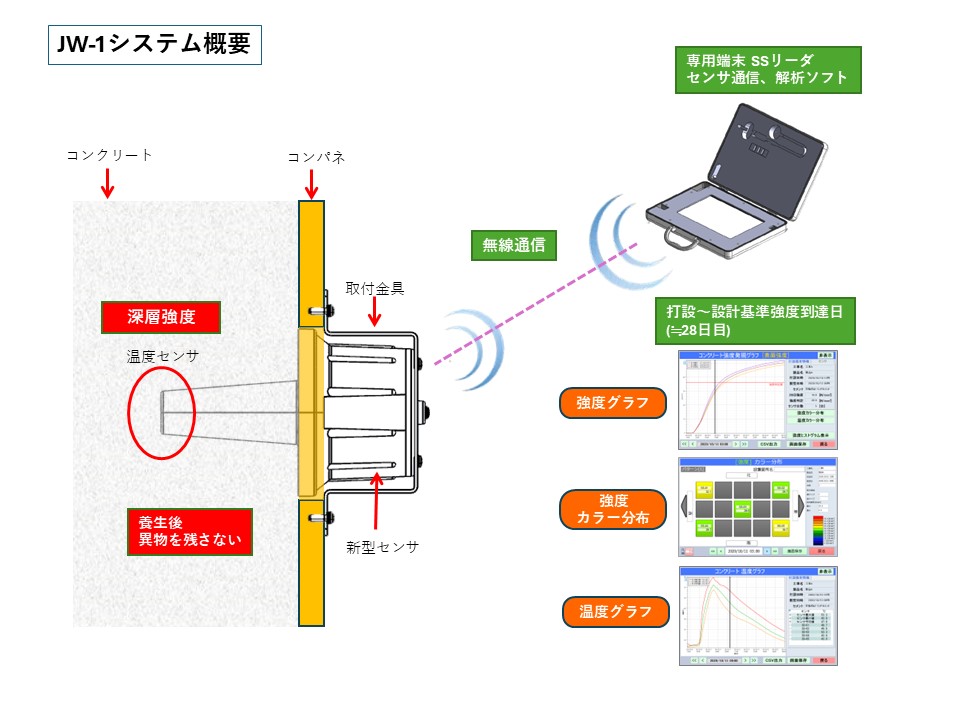
トンネル二次覆工のコンクリート打設の際セントルに加わる圧力を計測する装置
Real-Time Pressure Monitoring Device for Tunnel Secondary Lining Formwork
トンネル二次覆工のコンクリート打設の際、セントル型枠マシーンに加わる圧力は、一般的に最大100kPa(100kN/m²)と言われます。ポンプ車でコンクリートを圧送する現場において、セントルに加わる圧力が時々刻々と変化していく進捗情報は、人命に関わる重要な情報であり、信頼性が求められる装置と言えます。
従来は土圧計が使用されていますが、本装置には、薄暗いトンネル坑内での使用に特化し、LEDが光って圧力の強さを可視化する機能を搭載しました。さらに、バイブレーターの打撃による損傷を激減させるべく、受圧面積を25分の1、わずか4%に削減しました。
また、制御盤、モニター画面、パトライト、警報ブザーも装備しており、時々刻々と瞬時に変化する圧力を光と音で知らせることも可能な、安全に特化した技術です。
During concrete placement for tunnel secondary lining, the pressure applied to the centering formwork is generally said to reach a maximum of 100 kPa (100 kN/m²). At sites where concrete is pumped, real-time information on pressure that changes from moment to moment is critical to human safety and therefore requires a highly reliable monitoring device.
While conventional earth pressure gauges are commonly used, our system is specifically designed for dark tunnel environments and features LED indicators that visualize pressure intensity through light. Furthermore, to drastically reduce damage caused by vibrator impacts, we have reduced the pressure-receiving area to just 4% (1/25) of that of conventional models.
Equipped with a control panel, monitor screen, signal tower lights, and an alarm buzzer, this safety-focused technology instantly alerts workers to fluctuating pressure through both light and sound.
住宅基礎コンクリートの品質向上に資するICT活用システム
Smart Quality Assurance System for Residential Concrete Foundations
建築工事の施工指針であるJASS 5が、2022年に【環境配慮・高品質化・合理化・効率化を目指して13年ぶりに大改訂】が行われました。上物の柱材・壁材・床材などの耐久性能が70年~100年時代へと移行していくなか、基礎コンクリートもようやく一般コンクリートと同等の管理基準の仲間入りをしたわけですが、戸建て住宅の現場管理は多忙を極め、1人の監督員が複数の現場を管理しているのが現状です。
コンクリートの耐久性能は、初期養生で決まると言っても過言ではありません。
したがって、脱型までの管理履歴と脱型強度確認は非常に重要な管理目標となります。しかし、現場管理者不足のこの状況下では、従来型の供試体圧縮強度管理は大きな負担としてのしかかってきます。
現場からは、少人化・省力化が望まれる時代に、これ以上の負荷はかけられません。そこで考えられるのが、JASS 5にも掲載された【環境配慮・高品質化・合理化・効率化】を推進するためにも、ICTを活用した合理化が図れないかという考えから、本システムが考案されました。
戸建て基礎型枠の主流であるメタルフォームに、センサをマグネット治具でワンタッチに取り付けられ、脱型基準強度の確認後は、またワンタッチで取り外せる構造です。
温度履歴やグラフ表示などのリアルタイム情報は、無線通信でクラウドに送信され、全国どこにいても情報の共有が可能です。
In 2022, JASS 5 (Japan’s standard specification for building construction) underwent its first major revision in 13 years, emphasizing environmental sustainability, high quality, and operational efficiency. As the design service life for superstructural components like columns and floors shifts toward 70–100 years, residential foundations are now managed under standards equivalent to those for general concrete. However, with site managers often overseeing multiple detached-house projects, conventional specimen testing has become a significant burden.
Since concrete durability is largely determined by early-stage curing, monitoring history and confirming strength prior to demolding are critical benchmarks. Our system utilizes ICT to streamline these processes, aligning with JASS 5 goals without increasing on-site workload.
The sensors are easily attached to metal forms—the mainstream in residential foundations—using a one-touch magnetic fixture, and can be removed just as quickly. Real-time data,